Planning your text-messaging campaign
| Region | Compliance |
|---|---|
| United States |
Federal Communications Commission (https://www.fcc.gov) The FCC regulates mobile text messaging under the TCPA (Telephone Consumer Protection Act). |
|
CTIA (https://www.ctia.org) Best practices and guidelines are compiled and monitored by the CTIA, which creates compliance requirements, publishes a handbook detailing these requirements, and audits messaging programs for compliance with its standards. |
|
| Canada |
Canadian Wireless Telecommunications Association (https://www.cwta.ca/) The CWTA website provides up-to-date information on regulations for sending commercial electronic messages (CEM) under the Canadian Anti-Spam Legislation (CASL). |
| United Kingdom |
Advertising Standards Authority (https://www.asa.org.uk/) The ASA is the United Kingdom's independent advertising regulator, which administers the Committee on Advertising Practice (CAP) and the Broadcast Committee of Advertising Practice (BCAP). Consult The CAP Code: The UK Code of Non-broadcast Advertising and Direct & Promotional Marketing for guidance on SMS content standards for your industry. |
|
Data Protection Act (https://www.gov.uk/data-protection) The DPA governs how businesses handle personal information. You can collect customer data only for specified, explicit purposes and must keep it no longer than is necessary. Note: The DPA is the United Kingdom's implementation of the General Data Protection Regulation (GDPR). |
|
|
General Data Protection Regulation (https://gdpr.eu/) The GDPR is the European Union's data privacy and security law, which applies to all companies and organizations that target or collect data about customers in EU countries. |
|
|
Information Commissioner's Office (https://ico.org.uk/) The ICO is an independent regulator responsible for protecting data and information rights in the United Kingdom. |
|
|
Short-Codes.com (https://www.short-codes.com/) Short-Codes.com, which is run by the Shortcode Management Group (SCMG), allocates and approves short code activation requests in the United Kingdom. Consult the Code of Practice for Service Delivery of Common Shortcodes in the UK for all Communications Media for guidance on services that operate on short codes. |
|
|
Privacy and Electronic Communications Regulations (https://ico.org.uk/for-organisations/guide-to-pecr/) The PECR implement the EC Directive on privacy rights relating to electronic marketing messages. |
To set up a compliant text-messaging campaign:
Promoting your campaign
Your text-messaging campaign starts with a keyword and short code or long code combination:
-
Your customer success manager will help you to work with your mobile messaging provider and obtain the code that identifies your text-messaging campaign. For more information, see Working with short codes and long codes.
-
When you set up your campaign, you'll specify a keyword that mobile users can text to the short code or long code number in order to begin the opt-in process. For more information, see Opt-in messages.
When you have set up the opt-in path for your campaign, you are ready to promote it with a call to action (CTA) encouraging mobile phone users to text a keyword to a special code or to provide the mobile user’s cell phone number on a web form, in a phone contact, or on a sign-up form, etc.
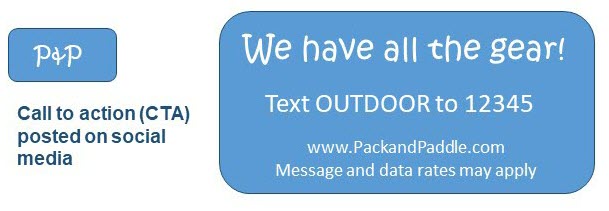
Take the time to design an effective message that will build a list of subscribers for your messaging program:
- Be clear and concise, keeping your CTA focused on a single response — texting a memorable keyword to a specific code.
- Emphasize the value your program provides, giving the users an incentive to respond and to anticipate recurring messages in the future.
Plan a program that gets your CTA out to your target audience in a well-crafted promotion across a variety of channels, such as social media and broadcast, print, and online outlets.
Tip: Be sure to set up your campaign with an opt-in path message BEFORE you advertise your CTA promotion. For more information, see Building a new campaign.
Obtaining subscriptions
After you set up and promote your call to action, mobile users can subscribe to your compliant text-messaging campaign, as follows:
-
In response to call to action, a mobile user texts a keyword to a short code or long code (opt-in 1).
-
Waterfall responds with an opt-in message requesting confirmation or the user's date of birth (age verification).
-
The mobile user then responds YES to confirm (opt-in 2) or supplies a qualifying date of birth.
The user is now subscribed to your campaign, and you can send messages to their mobile device.